
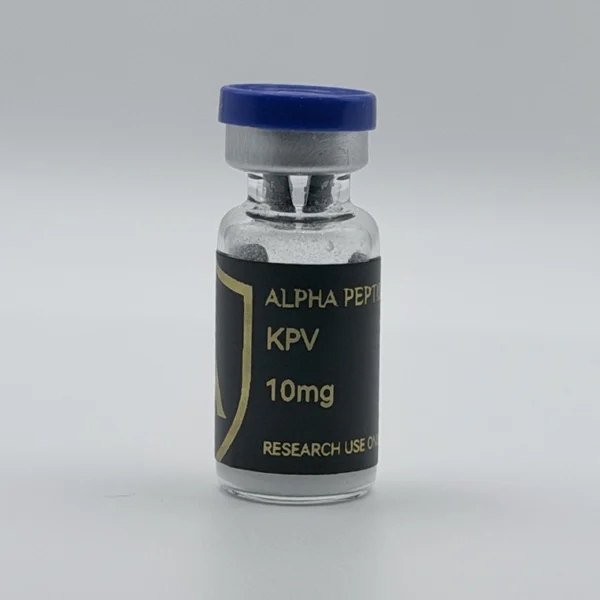
KPV is a tripeptide with the amino-acid sequence lysine–proline–valine. It corresponds to the final three residues of alpha-melanocyte-stimulating hormone, usually abbreviated to alpha-MSH. Researchers have investigated this fragment in experimental models of inflammatory signalling. A 2008 study identifies KPV as alpha-MSH(11–13).
For anyone reading KPV research, the most useful question is specific: what did the experiment demonstrate in the system being tested? The answer becomes clearer when the material, model and result stay together.
This article introduces selected preclinical work. It does not attempt to catalogue every KPV paper or establish clinical applications.
What does the name KPV tell you?
K, P and V are the one-letter amino-acid codes for lysine, proline and valine. The sequence identifies the fragment being discussed; it does not mean that every property of the full alpha-MSH molecule transfers to KPV.
When comparing papers, note the complete material description. If a study specifies a modified peptide or a particular formulation, preserve that detail in your summary. “KPV research” is a useful search phrase, but it is only the beginning of a careful comparison.
Why does PepT1 appear in KPV research?
Dalmasso and colleagues investigated KPV uptake and its relationship to PepT1 in intestinal epithelial and immune-cell experiments. The researchers reported that KPV was transported into cells through PepT1. This makes cellular uptake a relevant part of interpreting the experimental response. See the 2008 PepT1 study.
For a laboratory reader, this raises a useful question: does the model being considered have the features examined in the original paper? A result in one cell system should not be assumed to apply to another without supporting evidence.
What have animal experiments measured?
For a three-paper comparison, read KPV Animal Studies: What Mouse Colitis Models Actually Show. Our guide to interpreting peptide research explains how these findings differ from human evidence.
Kannengiesser and colleagues examined KPV in two mouse models of intestinal inflammation: DSS colitis and CD45RB-high transfer colitis. Their assessment included tissue histology and myeloperoxidase activity, alongside changes in body weight. They reported reduced inflammatory changes under the conditions tested. Experiments involving a nonfunctional MC1 receptor suggested that the observed effects were at least partly independent of that receptor. Read the study abstract.
These are preclinical observations. The model, endpoints and limitations belong in any description of the result. A study of experimentally induced disease in mice does not establish treatment effectiveness in people.
What about NF-κB signalling?
A separate airway-epithelium study reported suppression of NF-κB signalling and linked KPV activity to inhibition of p65RelA nuclear import. This is a different experimental setting from the intestinal work. See the airway-epithelium research.
The research value lies in comparing the questions each experiment addresses. Cellular uptake, movement of a signalling component and tissue changes are different observations. Treating them as interchangeable loses useful information.
A practical way to compare KPV papers
- Record the material: sequence, any stated modifications and formulation.
- Name the model: specify the cells or animal system and the experimental stimulus.
- List the endpoints: write down what was measured before summarising what the authors concluded.
- Keep the limits visible: note controls, replication and questions the study did not answer.
A short evidence table can do more work than a long list of citations. Give each paper its own row so differences remain visible.
Frequently asked questions
Is KPV the same as alpha-MSH?
No. KPV describes the three-residue fragment discussed above. Alpha-MSH is the parent peptide; their names should not be used interchangeably.
Do these papers prove human safety or efficacy?
No. The selected studies are preclinical. Their findings support research questions within the tested models, without establishing human safety or clinical outcomes.
Where can a laboratory review KPV product details?
The KPV 10mg listing contains current product information. Use the certificate-of-analysis guide when reviewing documentation, and contact Alpha Peptides® if a material detail needs clarification.
Explore the Research Library for more compound profiles and laboratory reading guides.
Alpha Peptides® products are supplied strictly for in vitro and laboratory research. They are not for human consumption or veterinary use. This article provides research-literature context and no administration advice.