
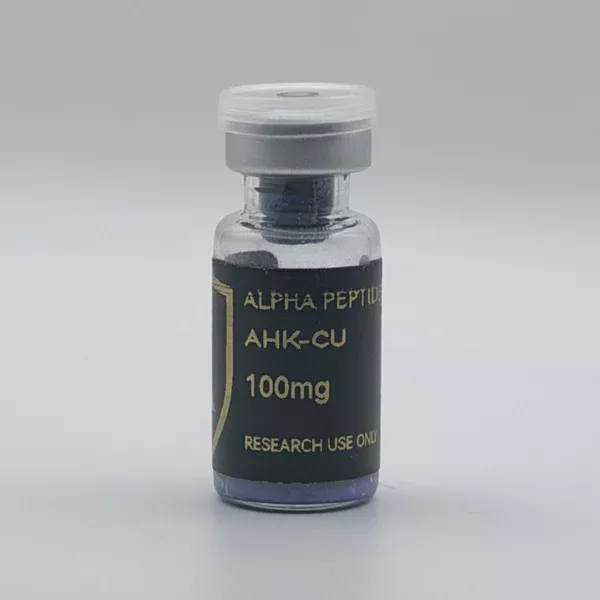
AHK-Cu and GHK-Cu are different copper-binding tripeptides. AHK contains alanine–histidine–lysine; GHK contains glycine–histidine–lysine. The first amino acid changes, while the final two remain the same. These identities are described in the AHK-Cu study by Pyo and colleagues and the GHK-Cu study by Maquart and colleagues.
For a researcher comparing the two, the useful questions are straightforward: which material did a study investigate, which experimental model did it use, and what did it actually measure?
AHK-Cu and GHK-Cu at a glance
| Point of comparison | AHK-Cu | GHK-Cu |
|---|---|---|
| Peptide sequence | Alanine–histidine–lysine | Glycine–histidine–lysine |
| First amino acid | Alanine, abbreviated A | Glycine, abbreviated G |
| Meaning of Cu | Copper complex of AHK | Copper complex of GHK |
| Example research model | Isolated human hair follicles and cultured dermal papilla cells | Fibroblast cultures |
| Example measured outcome | Follicle elongation and cell proliferation | Collagen synthesis |
| Primary source | Pyo et al., 2007 | Maquart et al., 1988 |
These are examples from separate papers, rather than an exhaustive account of either compound’s research history. The table does not represent a direct comparison experiment.
What does the AHK-Cu paper show?
Pyo and colleagues investigated AHK-Cu using isolated human hair follicles outside the body and cultured dermal papilla cells. They reported increased follicle elongation and cell proliferation in those models. A measured reduction in apoptotic cells did not reach statistical significance. Read the original study abstract.
The distinction between a human tissue experiment and a trial in people matters. An observation in an isolated follicle does not establish an effective treatment for hair loss.
What does the GHK-Cu paper show?
Maquart and colleagues reported that GHK-Cu stimulated collagen synthesis in fibroblast cultures. The effect was independent of a change in cell number. This was a laboratory finding; it does not establish a cosmetic or clinical outcome in people. Read the original study abstract.
Can you say that one copper peptide is better?
The two papers above do not provide a basis for that ranking. They investigate different questions using different experimental systems. Comparing the apparent size of an effect across unrelated studies would not establish that one compound performs better.
A useful comparison would need a defined outcome, suitable controls and comparable conditions. “Better” becomes meaningful only after the research question is specified. This is a limitation of the comparison presented here, not a claim that these two papers cover all available evidence.
What should you check before selecting a research material?
Start with the material described in the relevant paper. Check the full name, sequence, copper-complex designation and product specification. A shared “copper peptide” label is too broad to establish that two materials match.
- Identity: does the documentation identify the compound your study requires?
- Batch: can the available analytical report be connected to the supplied material?
- Specification: are quantity, physical form and storage instructions clear?
- Evidence: does each result relate to the question you need answered?
Analytical purity and peptide content describe different properties; a purity percentage alone does not establish how much peptide is present. Bachem explains these quality-control distinctions. For a practical walkthrough, see our guide to reading a peptide COA.
Common questions
Are AHK-Cu and GHK-Cu interchangeable?
They have different peptide sequences. Treat a substitution as a change to the research material that needs justification within the study design.
Does research involving human cells prove benefits in people?
A cell or isolated-tissue result answers a question about that experimental model. Establishing a benefit in people requires evidence that addresses the proposed human outcome.
Explore the research specifications
Review the current specifications for AHK-Cu 100mg and GHK-Cu 100mg, together with our Testing & Documentation information. Contact us if you need clarification about the documentation available for a particular product.
For laboratory research and education only. Research materials are not intended for human or veterinary use. This article provides no dosing or administration guidance.