
Alpha Peptides® research library
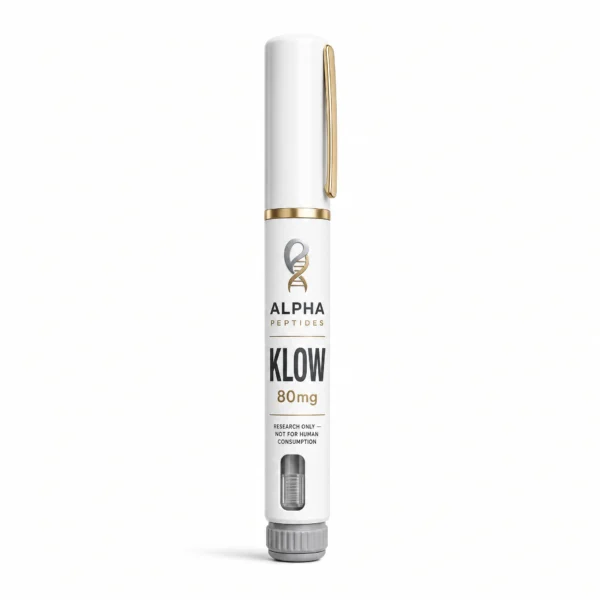
KLOW is a four-component research peptide blend containing GHK-Cu, BPC-157, TB-500 and KPV. In the 80mg formulation supplied by Alpha Peptides®, the nominal split is 50mg of GHK-Cu and 10mg of each of the other three compounds.
Our UK catalogue includes a KLOW research pen and a vial listing. Both sit within our laboratory research range, with UK-only delivery from Kent. This guide explains the ingredients, the meaning of the 80mg label and the scientific background to the blend.
The four components of KLOW
| Compound | Labelled amount |
|---|---|
| GHK-Cu | 50mg |
| BPC-157 | 10mg |
| TB-500 | 10mg |
| KPV | 10mg |
GHK-Cu makes up the largest portion by labelled mass. The other three components each account for 10mg. These quantities describe the formulation; they are not doses or instructions for use.
GHK-Cu: copper and connective-tissue research
GHK-Cu is a copper complex of the peptide glycyl-histidyl-lysine. Its research literature includes the extracellular matrix, the material surrounding cells that contributes to tissue structure.
In a 1993 rat wound-chamber experiment, Maquart and colleagues reported increased accumulation of collagen and other matrix components following GHK-Cu exposure. This was a measurement in an experimental animal model. [1] Our GHK-Cu animal-studies article covers this work alongside other models with differing results.
BPC-157: tendon cells and experimental repair models
BPC-157 is a 15-amino-acid peptide examined in preclinical research. A 2011 study by Chang and colleagues used rat tendon tissue and cultured tendon fibroblasts. The authors reported increased cell outgrowth, movement and survival under stress, but no direct increase in cell proliferation in their assay. [2]
Those are distinct observations: cells moving or surviving is different from cells multiplying. Our BPC-157 tendon-research review explains the tissue study alongside experiments in living rats.
TB-500: the component named in the batch report
The KLOW source-batch report lists this component as TB-500 (TB4) and records 10.02mg in the submitted sample. We retain that terminology when describing the result.
The report provides a component measurement. It does not describe a biological experiment with KLOW or demonstrate a particular effect of TB-500 within the four-component blend.
KPV: a tripeptide studied in inflammatory models
KPV stands for lysine–proline–valine, a three-amino-acid peptide. Dalmasso and colleagues investigated KPV uptake through the PepT1 transporter alongside cell experiments and mouse models of intestinal inflammation. They reported reduced intestinal inflammation in the tested animal models. [3]
Our KPV mouse-colitis research article explores these findings and related studies in more detail.
What ingredient studies tell us about KLOW
These papers explain why the individual compounds attract research interest. They investigate particular substances in particular experimental settings. None of the studies summarised above tests the Alpha Peptides® KLOW pen.
A four-component formulation introduces a different scientific question: how the combined material behaves. Ingredient findings alone do not establish that the blend produces the same effects, or that combining the ingredients creates synergy. Our guide to peptide research evidence explains the distinction between cell studies, animal models and human trials.
Why the report and label show different amounts
The label gives the nominal 80mg formulation. Janoshik report #167220 records the measured amounts in one submitted sample from source batch 2026-06. The four results total 87.20mg, including the copper within GHK-Cu.
The label and report describe different things: the named product strength and the laboratory measurement of the sample. The report does not establish that every finished pen contains exactly 87.20mg. The individual results and their meaning are set out in our KLOW batch-report explanation.
KLOW research pens and vials in the UK
Alpha Peptides® supplies the KLOW 80mg research pen and KLOW 80mg vial to UK customers. Our pens are prepared from our vial products, and orders are dispatched from Kent. We deliver only within the UK.
The product pages show current price and availability. For documentation questions, contact the Alpha Peptides® team.
For laboratory and in vitro research only. Not for human consumption, veterinary use, or medical, therapeutic, cosmetic, diagnostic or administration purposes.
Sources
- Maquart FX et al. (1993). GHK-Cu and connective-tissue accumulation in rat experimental wounds. Journal of Clinical Investigation, 92:2368–2376.
- Chang CH et al. (2011). BPC-157, tendon outgrowth, cell survival and cell migration. Journal of Applied Physiology, 110:774–780.
- Dalmasso G et al. (2008). PepT1-mediated KPV uptake and intestinal inflammation. Gastroenterology, 134:166–178.
- Janoshik component report #167220, batch 2026-06, analysed 18 June 2026. Alpha Peptides® analytical summary; source report available on request.
The research overview summarises selected published findings; it is not a systematic review of the four compounds or the KLOW blend.