
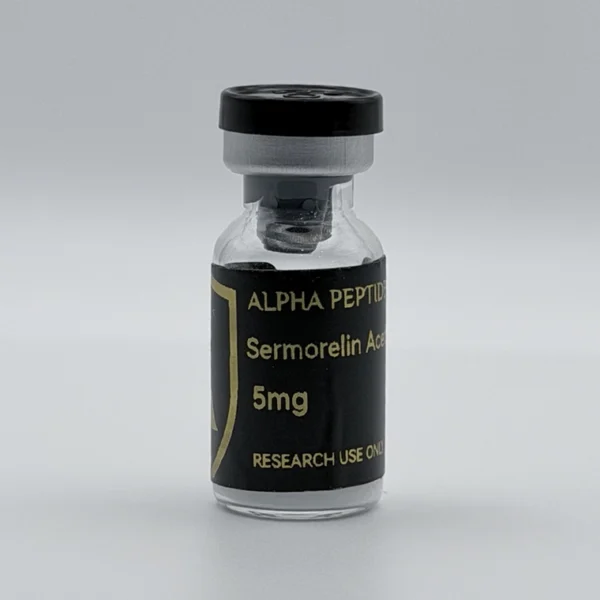
Sermorelin is a synthetic peptide corresponding to the first 29 amino acids of growth hormone-releasing hormone, in an amidated form. You will also encounter the notation GHRH(1-29)-NH2 when reading about this research area.
It is important to distinguish the releasing signal from growth hormone itself. Mayo Clinic’s description of Sermorelin explains its action in stimulating growth hormone release from the pituitary gland. That description concerns a medical context; it does not establish suitability of a research vial for human use.
Sermorelin, GHRH and growth hormone: the distinction
GHRH stands for growth hormone-releasing hormone. GH stands for growth hormone. Treating the abbreviations as interchangeable makes a literature search less reliable because they refer to different molecules.
For a literature review, record the complete compound name and any sequence modifications. Do not group a study under “Sermorelin” merely because its title mentions GHRH. Check the methods to identify the material actually investigated.
Our growth hormone signalling overview introduces the wider research area. It is a useful companion when navigating papers that measure different parts of the same endocrine system.
What have GHRH(1-29) studies measured?
A 1997 study by Vittone and colleagues examined 11 men aged 64–76 with low baseline IGF-I levels over six weeks. The investigators measured overnight GH secretion, IGF-I, body composition and several muscle-function outcomes.
They reported increased nocturnal GH release, without a change in IGF-I or GH pulse frequency. Some strength and endurance measurements improved, while body weight and measured muscle and fat composition did not change.
Those mixed findings are useful. They show why an increase in one hormone measurement should not be presented as proof of improvement across every downstream outcome. The small study population and short observation period also limit generalisation.
Why the study population matters
The literature includes very different populations. For example, Kirk and colleagues’ 1994 study investigated GHRH(1-29)NH2 in children with idiopathic short stature over 12 months.
A paediatric growth study and a short study in older men address different questions. They should remain separately described, with their populations and endpoints visible. Neither can serve as a general promise about what a commercial research product will do.
How to assess a Sermorelin research claim
- Check the molecule: look for the complete name, sequence and terminal modifications in the methods.
- Check the population: age, baseline physiology and selection criteria affect what can be concluded.
- Check the endpoint: hormone concentration, body composition and functional outcomes are distinct measurements.
- Check the comparison: identify controls, follow-up duration and outcomes that did not change.
- Check the conclusion: distinguish a measured response from a claim about long-term benefit.
A useful summary includes the negative or unchanged findings. Removing them may make the headline more exciting, but it makes the account of the experiment less accurate.
Sermorelin research documentation
The Alpha Peptides® Sermorelin 5mg listing provides the stated product specification. Before selecting research material, compare that specification and the available batch documentation with the identity required by the study you intend to investigate.
Our guide to reading a Certificate of Analysis covers practical documentation checks. Record the batch and the analytical evidence available, and keep any unanswered specification questions visible in your research records.
For research information only. Alpha Peptides® research materials are not intended for human or veterinary use. The studies discussed do not establish that commercial research products are suitable for treatment.
For wider catalogue context, see our Growth Hormone Research collection. Compare each material separately rather than assuming a shared mechanism.
Leave a Reply