
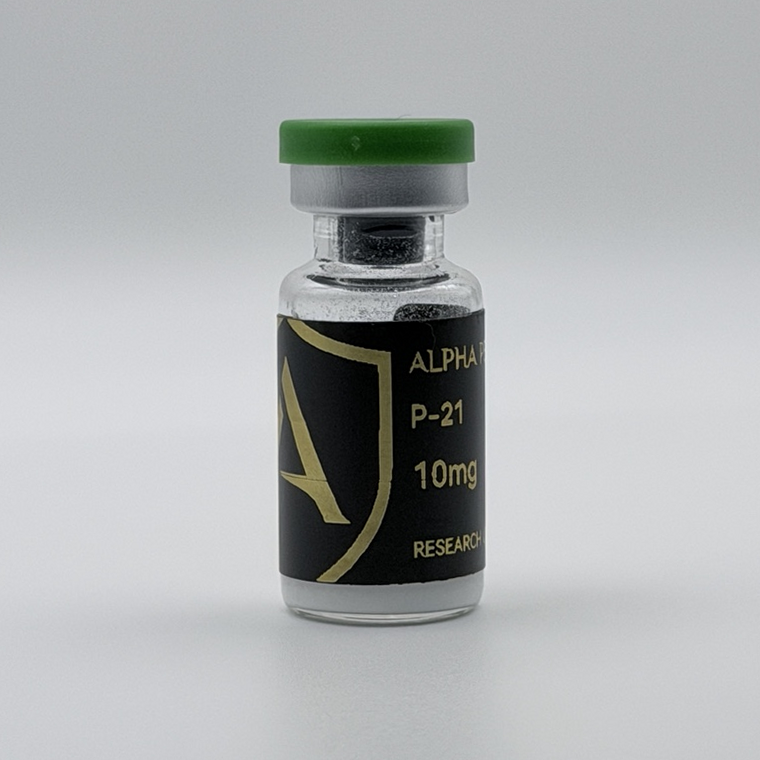
P-21 is a chemically modified short peptidomimetic developed from a sequence derived from ciliary neurotrophic factor (CNTF). Its research story concerns neurotrophic signalling, learning-related behaviour and neuronal markers—not established benefits for people.
Before getting lost in the terminology, there are three useful questions: what molecule was tested, in which experimental model, and what actually changed?
Where does P-21 come from?
In a 2010 study by Li and colleagues, researchers developed shorter compounds from a CNTF-derived peptide. P21 incorporated an adamantane-containing modification. This was a designed derivative, not simply a smaller vial of CNTF.
The distinction matters when reading about peptide families. Sharing an origin with a larger protein does not establish that a derivative reproduces all of that protein’s actions.
What did the mouse study examine?
The same study examined normal adult mice using behavioural tasks, including object recognition and a water maze, alongside measures related to neurogenesis and synaptic proteins. The authors reported improvements in learning-related measures and changes in neuronal and synaptic markers.
Results were not uniform across every test and time point. These experiments support further investigation in their specific models; they do not establish improved cognition, disease treatment or safety in humans. Read the original paper’s methods and results together, rather than treating its headline as the whole finding.
Why the exact identity matters
A short name is handy. It is not a substitute for a molecular identity.
When comparing a paper with a catalogue entry, check the stated sequence, terminal modifications and analytical documentation. Do not assume that similar abbreviations mean identical compounds.
There is another naming trap: the human protein commonly called p21 is associated with the CDKN1A gene, which encodes a cyclin-dependent kinase inhibitor. It is not the CNTF-derived research compound discussed here. Adding “CNTF-derived peptide” to a literature search helps keep those subjects separate.
Four checks before interpreting a P-21 paper
- Compound: does the molecular description match the material you are investigating?
- Model: is the work in cells, healthy animals or a disease model?
- Endpoint: was the result behavioural, molecular or structural?
- Limit: which outcomes were unchanged, uncertain or outside the study’s scope?
Keep reported findings separate from the authors’ proposed explanations. A measured change and a suggested mechanism answer different questions.
What should accompany a research material?
A publication describes an experiment; it does not verify a separately supplied batch. For procurement review, compare the product specification with the available identity, purity and batch documentation. If a document is missing or unclear, request it rather than filling in the gaps.
See the Alpha Peptides® P-21 10mg product listing for its stated specification, and our guide to reading a Certificate of Analysis for a documentation checklist.
Research context only. Alpha Peptides® research materials are not intended for human or veterinary use. This article provides no dosing, administration or treatment guidance.
Leave a Reply