
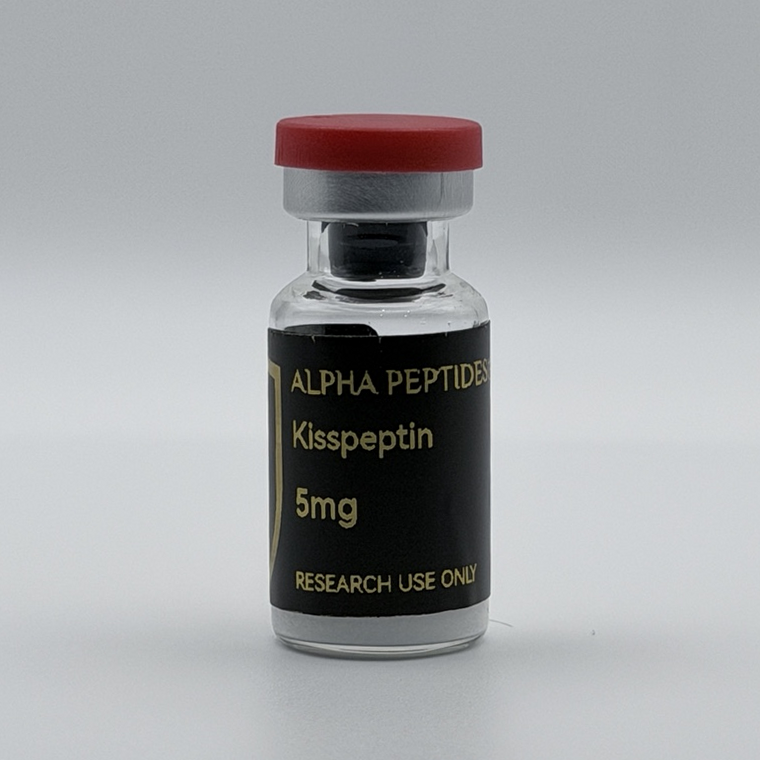
Kisspeptin-10 is a ten-amino-acid member of the kisspeptin family, investigated for its activity at the kisspeptin receptor, KISS1R, also called GPR54. It shares the C-terminal sequence found in longer kisspeptins. The background to George and colleagues’ 2011 study explains this relationship.
The number in the name matters. A paper about “kisspeptin” may examine a different peptide length, and that detail should travel with any summary of its results.
Where did kisspeptin research begin?
In Kotani and colleagues’ 2001 study, researchers identified naturally occurring KISS1-derived peptides that activated GPR54. They studied receptor binding and cellular responses, including calcium mobilisation and changes in intracellular signalling.
This work helped connect the peptide family with a previously orphan receptor—a receptor whose natural activating molecule had not yet been identified. It established a route for further biological investigation, rather than a ready-made clinical application.
Kisspeptin-10 versus Kisspeptin-54
Kisspeptin-10 contains ten amino acids; Kisspeptin-54 contains 54. Their shared active region explains why they are discussed together, but their different lengths mean they should remain separately identified in a literature review.
George and colleagues note differences in the timing and persistence of their activity in rodent experiments. Matching receptor activity is therefore not a licence to assume identical behaviour in every experimental setting.
Before comparing results, check the peptide form, species or participant group, measured endpoint and observation period. “Same family” is a starting point, not a complete comparison.
What have human studies examined?
In the 2011 study by George and colleagues, researchers investigated Kisspeptin-10 in healthy men. They measured luteinising hormone (LH) secretion, including its pulse pattern, and reported stimulation of LH release.
These were physiological measurements under controlled research conditions. They do not establish fertility outcomes, long-term safety or suitability of commercial research stock for treatment.
A separate 2011 study by Jayasena and colleagues found that responses differed between men and women and across menstrual-cycle phases. Under the conditions tested, gonadotropin release was stimulated in men and women in the preovulatory phase, but not in women in the follicular phase.
That finding illustrates why the study population belongs in the headline interpretation. A response in one physiological setting cannot simply be carried over to another.
Reading a hormone-signalling paper carefully
- Identify the molecule: Kisspeptin-10, Kisspeptin-54 or a modified analogue?
- Identify the system: receptor-expressing cells, an animal model or human participants?
- Identify the outcome: receptor signalling, a hormone measurement or a clinical endpoint?
- Identify the limits: what population, duration and unanswered questions constrain the conclusion?
Hormone measurements are valuable research endpoints. Their value depends on interpreting them precisely, without turning a measurable response into a promise of benefit.
Matching the literature to documentation
Review the Alpha Peptides® Kisspeptin-10 5mg listing for its stated specification, then compare available batch documentation with the molecular identity relevant to your research.
For help organising those checks, see our guide to reading a Certificate of Analysis.
Research context only. Alpha Peptides® research materials are not intended for human or veterinary use. Studies discussed here do not establish that these products are suitable for treatment. No dosing or administration guidance is provided.
Leave a Reply