
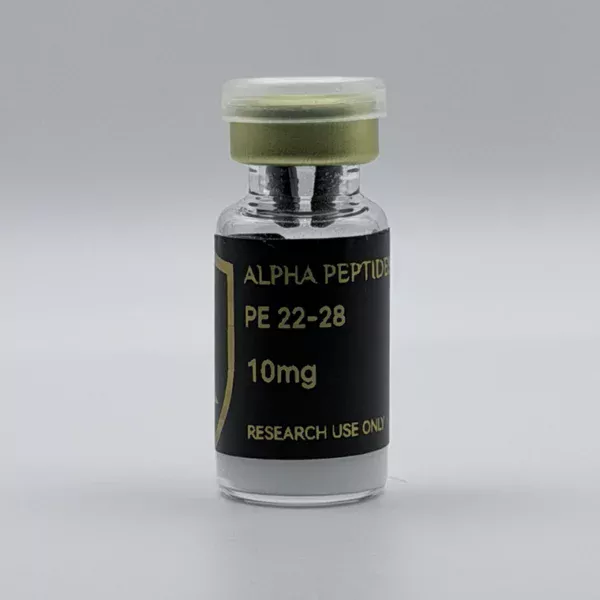
PE-22-28 is a seven-amino-acid experimental peptide investigated for inhibition of the TREK-1 potassium channel. It emerged from research on shorter forms of spadin, a peptide connected with sortilin biology. The key PE-22-28 findings discussed here come from Djillani and colleagues’ 2017 laboratory and mouse study.
The useful question is what was actually measured. An ion-channel result, a cellular marker and a behavioural observation each answer a different research question.
How is PE-22-28 related to spadin?
In Mazella and colleagues’ 2010 spadin study, researchers investigated a peptide derived from the propeptide released during sortilin maturation. They reported inhibition of TREK-1 activity in experimental cell systems and neuronal preparations, alongside findings in mouse behavioural tests.
This earlier work provides the background to the shortened-peptide research. It studied spadin; its findings should retain that molecular identity when cited. A result for the parent peptide cannot automatically be assigned to every fragment.
What did the PE-22-28 study examine?
The 2017 investigation compared shortened spadin-related peptides using electrophysiology: measurements of electrical currents across cell membranes. PE-22-28 inhibited TREK-1 in cells engineered to express the channel. The researchers also examined other potassium channels to investigate selectivity.
Separate experiments examined mouse behaviour and cellular markers associated with neurogenesis and synaptic biology. Some experiments included modified PE-22-28 analogues, so the exact molecule attached to each result matters.
What does TREK-1 inhibition tell researchers?
It identifies an experimental effect on a defined target. It does not, by itself, tell us whether a compound produces a useful clinical outcome. Channel activity and patient outcomes sit at different levels of evidence.
When comparing papers, record the cell system, experimental conditions, comparator and measured endpoint. A numerical potency comparison is meaningful only alongside those details. It is not a measure of how much better a substance would work in a person.
Why animal findings need careful wording
The behavioural experiments in the cited PE-22-28 paper used mice. Such experiments can help researchers investigate hypotheses, but they do not establish human benefit, long-term safety or a treatment protocol.
Likewise, a change in a cellular marker should be described as that measured change. It should not become a claim about improved memory, mood or everyday functioning. Keep the conclusion at the level the experiment supports.
A checklist for reviewing PE-22-28 research
- Molecule: distinguish PE-22-28 from spadin and chemically modified analogues.
- Model: record whether the experiment used engineered cells, neuronal preparations or animals.
- Endpoint: separate channel currents, cellular markers and behaviour.
- Evidence limits: check sample sizes, controls and whether independent studies reproduce the finding.
For another example of interpreting experimental neuropeptide evidence, read our P-21 research overview. Similar areas of interest do not make the compounds interchangeable.
Matching the paper to a research specification
The Alpha Peptides® PE-22-28 10mg listing sets out the stated product specification. Compare the molecular identity and available batch documentation with the material required by your research plan.
Use our guide to reading a Certificate of Analysis to organise those checks. A published study and a supplier’s batch report answer different questions: one concerns experimental findings; the other concerns the documented sample.
For research information only. Alpha Peptides® research materials are not intended for human or veterinary use. The studies discussed do not establish that commercial research products are suitable for treatment.
Leave a Reply