
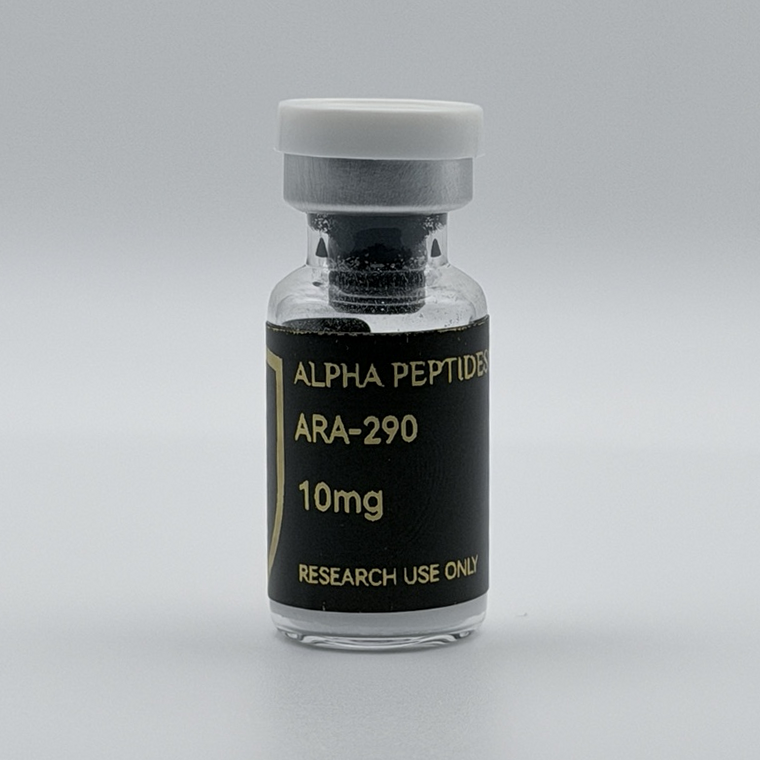
ARA-290 is an 11-amino-acid research peptide developed from the structure of erythropoietin (EPO). Its design explores whether particular biological responses can be investigated separately from EPO’s role in red blood cell production.
That is an interesting research question. It is not, by itself, a statement that the compound is an established treatment.
How is it different from erythropoietin?
EPO is a much larger protein. ARA-290’s design traces to a short sequence representing part of the exposed surface of EPO’s helix B, rather than reproducing the whole molecule.
In Brines and colleagues’ 2008 study, EPO-derived peptides were investigated in preclinical injury models. The researchers reported tissue-protective activity without erythropoietic activity in the experimental systems they tested.
The phrase “nonerythropoietic” describes that separation from red blood cell production. It should not be read as a general guarantee of safety or as evidence that every other action of EPO is preserved.
What does “innate repair receptor” mean here?
The 2012 ARA-290 pilot study describes the compound as designed to activate the innate repair receptor. This terminology explains the proposed biological target; it does not establish a clinical outcome. The receptor’s name is not the study result.
Has ARA-290 been studied in people?
Yes. In that randomised, double-blind pilot, 22 people with sarcoidosis and symptoms of small fibre neuropathy received ARA-290 or placebo over four weeks.
The small-fibre-neuropathy screening measure improved more with ARA-290, but Brief Pain Inventory and fatigue scores improved similarly in both groups. Those distinctions matter: the paper should not be compressed into “proved to relieve pain”.
A short, small pilot cannot establish long-term safety, effectiveness across other conditions or equivalence between clinical study material and a commercial research product. Its findings are a reason for further investigation, not permission for self-experimentation.
How to read the evidence without overreaching
- Separate models: a result in an experimental injury model is not a patient outcome.
- Check the comparison: improvement within one group is different from improvement over placebo.
- Name the measure: symptom questionnaires, pain scores and laboratory markers are not interchangeable.
- Keep the population attached: findings in one defined patient group do not automatically apply elsewhere.
- Look for uncertainty: sample size, follow-up and inconsistent outcomes belong beside the positive findings.
What does this mean for research procurement?
Start with the material’s stated identity and the documentation available for its batch. A paper about a named compound is not a Certificate of Analysis for a product carrying that name.
Compare specifications, ask about missing analytical information and keep purchasing checks separate from interpretation of the literature. Neither a product label nor a purity figure establishes suitability for human use.
The Alpha Peptides® ARA-290 10mg listing provides the product’s stated specification. Our Certificate of Analysis guide explains what to look for in supporting documentation.
Research context only. Alpha Peptides® research materials are not intended for human or veterinary use. Clinical studies discussed here do not establish approval or suitability of these products for treatment. No dosing or administration guidance is provided.
Leave a Reply