
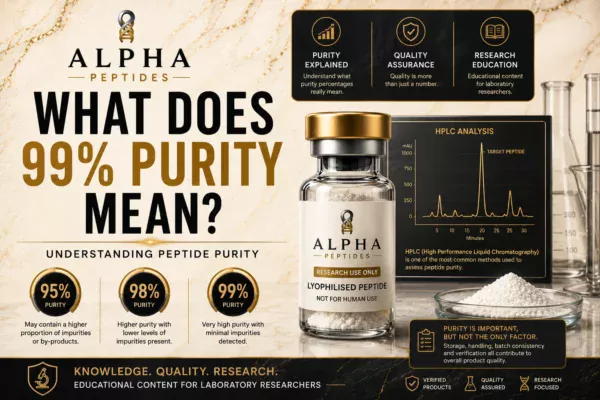
A peptide purity percentage needs its method and context. “99% purity” is not, by itself, a statement that 99% of the total contents of a vial is the intended peptide, nor is it a complete quality assessment.
What a chromatographic purity result reports
In a typical HPLC area-percentage calculation, the area assigned to the target peak is compared with the integrated peak areas detected under the stated analytical conditions. A result of 99% describes that measurement. It should not automatically be converted into the mass of peptide in the container.
Detection conditions, peak separation, integration and the substances the method can detect all affect interpretation. Components that are not detected or not separated can fall outside what a headline percentage tells you.
Purity, identity and content are different questions
Chromatographic purity concerns the reported analytical separation and detected peaks. Identity asks whether the material is the intended compound. Peptide content or assay concerns how much peptide is present under the relevant measurement method. Water, counterions and other components can affect material composition without being represented in the same way by a chromatographic area percentage.
A mass-spectrometry result may support a molecular-mass assignment, but it should be read alongside the method and supporting evidence. No single headline result answers every question about a sample.
What 99% does not prove
A high chromatographic purity result does not establish sterility, endotoxin status, the quantity in every vial, stability after preparation or suitability for human use. It also does not show that the document applies to every batch sold under the same product name.
What to check on the document
Look for the compound name, sample or batch reference, date, laboratory or report source, analytical method, results and supporting chromatograms where available. Ask which material was submitted, how it relates to the current stock and whether any additional testing is needed for your laboratory’s intended application.
Read our Certificate of Analysis guide and browse available analytical documentation. Documentation coverage varies by product and batch; our team can help clarify what is available.
Research use only: These materials are supplied for laboratory and scientific research. Analytical results do not constitute medical advice or permission for human or veterinary use.